




Pneumatics · Directional valves electric/pneumatic
5/3-Way Valves – Pneumatic Directional Control Valves with Defined Mid-Position
A 5/3-way valve has five ports and three switching positions – and it's precisely this third, middle position that determines how your cylinder behaves when no switching signal is applied. At STASTO, you can choose between mid-position closed, exhausted and pressurized – solenoid pilot operated or pneumatically with spring-centered mid-position, as an individual valve or as an ISO series to ISO 5599/1. Also known as a 5/3 valve or 5/3-way directional control valve.
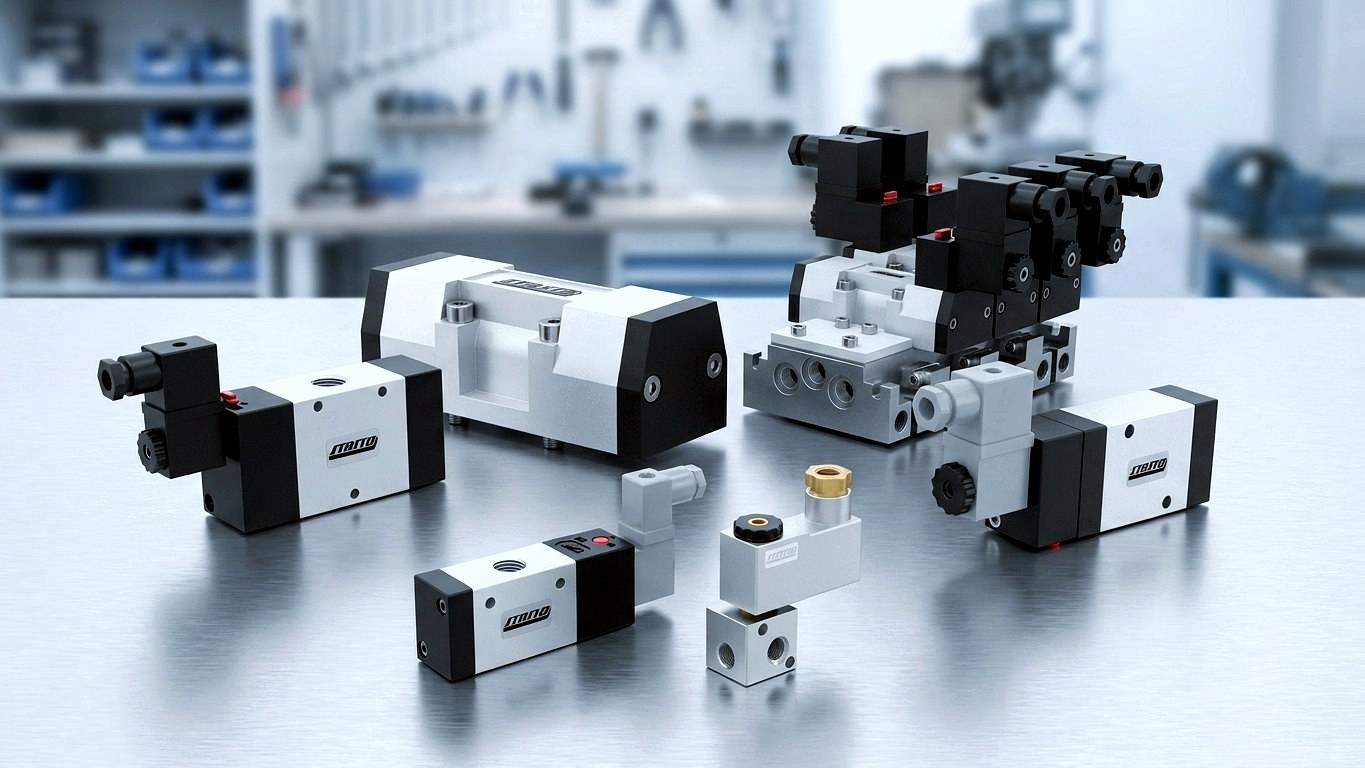
Series E5., K5.W, K5.P and PS112
Why STASTO
5/3-way valves that match your system's safety philosophy
The mid-position is embedded in the type code and clearly specified for each item. You choose the function to match the application – instead of adapting the application to the available valve.
Three mid-position variants from a single source
Blocked, exhausted, or pressurized – the function is clearly specified for each item. This lets you determine how the system behaves in the non-actuated state.
Electrically or pneumatically actuated
Pilot-operated electric/electric versions with solenoid coils and connector sockets (incl. 24 V DC, 24 V/50-60 Hz, 115 V/50-60 Hz, 230 V/50-60 Hz) – or purely pneumatic/pneumatic with spring-centered mid-position.
Consistent series design logic
Within a series, the port pattern, coils, and connector width remain consistent. This simplifies spare parts stocking, wiring, and documentation – even with combined 3/2, 5/2, and 5/3 functions.
Configuration instead of compromise
Valve, solenoid coil, and connector socket (standard, with LED and VDR, with molded PVC cable) can be ordered as a matched combination. Accessories such as silencers are assigned to the respective size.
Guide
How to select the right 5/3 way valve
The mid-position is the first and most important decision – followed by actuation type, port size, flow rate and electrics. The following terms outline the key selection criteria.
Understanding mid-positions
- Closed mid-position
- Both working ports are closed, keeping the air trapped in the cylinder chambers. The actuator holds its position approximately – available in the range with Series E5. and K5.W, among others.
- Exhausted mid-position
- Both working ports are open to exhaust, leaving the cylinder force-free and allowing manual movement – typical for set-up and changeover operations.
- Pressurized mid-position
- Both piston sides are pressurized, holding the actuator firmly clamped. Increases rigidity against external forces, for example in clamping and gripping functions.
- Spring-centered mid-position
- On the pneumatically actuated valves of Series K5.P, springs return the spool to the mid-position as soon as no control pressure is present.
Determining series and connection
- Actuation type
- Electric/electric pilot-operated for control from the PLC (Series E5., K5.W, PS112) or pneumatic/pneumatic for purely pneumatic control (Series K5.P).
- Connection and Nominal Size
- G1/8 with DN 6 mm, G1/4 with DN 8 mm, G1/2 with DN 14 to 15 mm. Base your choice on the required flow rate, not on thread size alone.
- Flow rate
- Depending on series and connection size, roughly 530 to 3500 Nl/min. Cylinder volume and desired stroke time determine air demand.
- ISO 5599/1
- Standard interface in sizes ISO1 (DN 8 mm, 800 Nl/min) and ISO2 (DN 13 mm, 1800 Nl/min) – swap for a valve of the same size without modifying the sub-base.
Electrics and Accessories
- Coil voltage
- Including 24 V DC, 12 V DC, 24 V/50-60 Hz, 115 V/50-60 Hz and 230 V/50-60 Hz – other voltages available on request.
- Connector socket (EN 175301-803)
- Standard, with LED and varistor for switching contact protection, or with molded PVC cable.
- Connector width
- 16 mm for Serie K, 22 mm for the E+V series (E5.) and PS112 – consider this when planning spare parts.
- Silencer
- For exhausted mid-position, consider exhaust routing and silencer; the correct assignment is stated on the item.
Comparison
Mid-position blocked, exhausted, or pressurized?
The three variants differ in how the actuator behaves when no switching signal is present. All three are available in the STASTO range.
| closed center | exhausted center | pressurized | |
|---|---|---|---|
| Working ports in mid-position | both closed | both open to exhaust | both pressurized |
| Cylinder behavior | holds position approximately | becomes force-free, can be moved by hand | remains firmly clamped in a defined position |
| Typical application | Intermediate stop for feed and lift axes | Setup, tooling changes, yielding in case of fault | Clamping, gripping, pre-tensioning |
| Examples, electrically pilot-operated | E53W2S612/614/618, K53W2S612/614/618 | E53W2S912/914/918, K53W2S912/918 | K53W2S312/314/318 |
| Examples, pneumatic, spring-centered | K53P2612/2614/2618 | K53P2912/2914/2918 | K53P2312/2314/2318 |
| ISO series acc. to ISO 5599/1 | PS112-I1-C / PS112-I2-C | PS112-I1-0 / PS112-I2-0 | on request |
Product Range
5/3-Way Directional Control Valves by Series
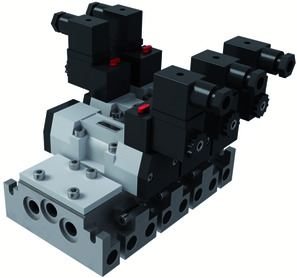
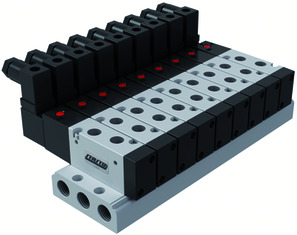
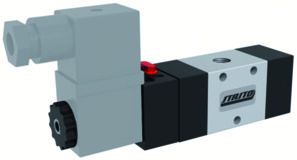
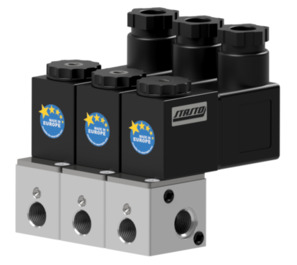
From the ISO series to ISO 5599/1, through the compact Series K, to Series E+V with 22 mm connector width – find the right category here.

Applications
Where 5/3-way valves are used
The third switching position determines how the system behaves when no signal is present – this is what makes 5/3-way valves interesting across a wide range of industries.
Positioning and intermediate stop
With a blocked mid-position, the piston remains approximately in the position reached – typical for feed and infeed axes as well as lifting and tilting movements. Due to the compressibility of air, this is a hold, not a form-fit positioning.
Depressurizing the actuator
In the exhausted mid-position, both working ports are vented, the cylinder becomes force-free and can be moved by hand – used during setup and changeover on handling axes.
Both sides under pressure
When both sides of the piston are pressurized, the actuator is held in a defined, clamped state. This increases rigidity against external forces – useful for clamping and gripping functions.
Valve and actuator control
On double-acting quarter-turn actuators for butterfly valves, ball valves and shut-off fittings, the third position provides defined behavior in the control system in case of signal loss.
Compact unit with NAMUR interface
Combined with the NAMUR interface, this creates a compact unit of actuator and valve – without additional piping. Special versions, such as ATEX designs, are clarified per variant on request.
Handling and infeed technology
On infeed and handling axes in packaging and filling lines, the mid-position enables controlled interruption or force-free yielding. We review media, temperature and cleaning requirements together with you for each variant.
Delivery and Availability
Ordering, Configuration and Availability
Availability differs by series, nominal size and coil/socket combination. Common combinations are usually available at short notice; special versions and non-standard voltages are clarified on a per-order basis. Current status and pricing can be found on the respective product page.

Order online or by inquiry
Order directly via the product page or by inquiry stating the type designation, for example E53W2S614 or K53P2614.
Quote with quantity discount
For series requirements, we prepare a quote with quantity-based pricing on request and confirm delivery date and version in writing.
Special versions
Please inquire about non-standard voltages, valve combinations and special versions – we check feasibility for each series.
Check technical limits
Pressure and temperature range, media and approvals are listed in the datasheet of the respective variant – we're happy to check suitability together with you.
How We Work
Three steps to the right 5/3 way valve
From the function decision to the complete combination of valve, coil, and connector socket.
Define mid-position and actuation
Blocked, exhausted, or pressurized – and electric/electric pilot-operated (Series E5., K5.W, PS112) or pneumatic/pneumatic with spring-centered mid-position (Series K5.P).
Determine Port Size and Flow Rate
G1/8 with DN 6 mm, G1/4 with DN 8 mm, G1/2 with DN 14 to 15 mm; approx. 530 to 3500 Nl/min depending on the series. If needed, we'll jointly decide between a single valve and an ISO series to ISO 5599/1.
Complete Electrics and Accessories
Coil voltage, connector (standard, with LED and VDR, or with molded PVC cable), plug width 16 or 22 mm, and a matching silencer – available as a coordinated package.
Frequently Asked Questions
5/3-Way Valves: Questions and Answers
The most important questions about function, mid-position, and series selection.
What does 5/3 mean for a directional valve?
5/3 means five ports and three switching positions. In addition to the two end positions for retracting and extending, there is a third, middle position. The five ports are one pressure port, two working ports, and two exhaust ports. A 5/2-way valve does not have this mid-position.
What mid-positions are available and when is each used?
There are three variants: closed (blocked), exhausted, and pressurized – all three are available in our range. Closed means both working ports are blocked and the actuator holds its position; exhausted means both working ports are open to exhaust and the actuator becomes force-free; pressurized means both piston sides are pressurized and the actuator is clamped in place. The choice depends on the desired behavior in the de-energized state.
Does a 5/3-way valve with a closed mid-position hold the load safely?
No, it only approximately holds the trapped air and thus the position – it is not a substitute for mechanical load holding. Since air is compressible and leakage through seals and fittings can never be completely ruled out, additional measures are required for safety-relevant holding.
What does spring-centered mid-position mean?
Spring-centered means that springs automatically return the valve spool to the mid-position as soon as no control pressure is applied. In the pneumatically actuated valves of the K5.P series, the mid-position is thus achieved without an electrical signal.
What are the differences between the E5., K5.W/K5.P and PS112 series?
The series differ in connector width, actuation, and connection concept: Series E+V (E5.) uses a 22 mm connector width and nominal sizes from 6 to 15 mm; Series K uses a 16 mm connector width and flows up to 3500 Nl/min, with K5.W electrically actuated and K5.P pneumatically spring-centered. The PS112 series follows ISO 5599/1 in sizes ISO1 and ISO2.
What is ISO 5599/1?
ISO 5599/1 is the standard for the port patterns of pneumatic directional control valves on sub-bases. It defines sizes such as ISO1 and ISO2, so valves of the same size can be swapped without modifying the sub-base – even across different series.
Is a 5/3-way valve solenoid or pneumatically operated?
Both are possible: solenoid pilot operated with solenoid coils and connectors, or purely pneumatic/air-piloted with spring-centered mid-position. Solenoid pilot operated series include E5., K5.W and PS112, while the K5.P series is purely pneumatic.
Which voltages and connectors are available?
Available voltages include 24 V DC, 12 V DC, 24 V/50-60 Hz, 115 V/50-60 Hz and 230 V/50-60 Hz. The connector is available in a standard version, with LED and varistor, and with a molded PVC cable; other voltages can be clarified on a project basis.
Goes Well With
Related Categories
Complementary components and adjacent valve functions for your pneumatic circuit.
Next Step
Find the Right 5/3-Way Valve
Already know the mid-position you need? Then go straight to our range. If flow rate, connection, or coil configuration are still open questions, we'll work out the right variant together with you.